If we cannot keep big money out of politics, we need to get more small money in.
Vermont has had a public financing system for certain races for nearly two decades. But it hasn’t been used for years and isn’t considered a viable option by many candidates.
That’s why VPIRG is advocating for new approaches to encourage candidates to raise more small-dollar contributions, increase voter participation, and provide the means for more voters to donate to their preferred candidates.
How Would Democracy Vouchers Work?
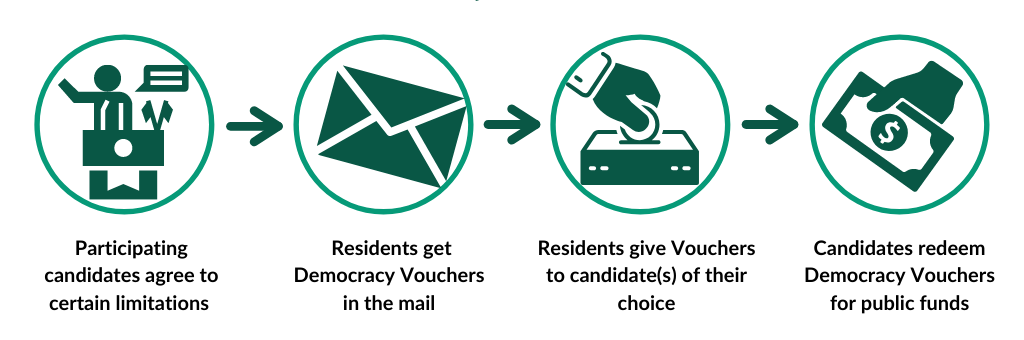
Democracy Vouchers allow more voters to contribute to their preferred candidates. Each election cycle, every registered Vermont voter would receive $25 worth of “Democracy Dollars,” which they could then donate to the qualified local politician(s) of their choice.
By giving Democracy Vouchers to voters, its incentives candidates to engage directly with communities and individuals not only for their votes, but for their financial support too.
The Goals:
- Increase voter engagement and participation
- Encourage candidates to court small dollar grassroots contributions in their districts
- Provide the means for more voters to contribute to their preferred candidates
A template for success…
Seattle was the first city in the U.S. to use Democracy Vouchers, doing so for city council races, and the success they have seen is promising. In 2017, the first election cycle for the program, Seattle found:
- Higher levels of participation among Democracy Voucher users
- 95% of Democracy Voucher users went on to vote in the general election, compared to just 43% of other Seattle residents
- More people made political contributions for the first time
- Over 20,000 Seattle residents used their Democracy Vouchers in 2017. 88% of them had never made a political contribution before, and the rate of individual contributions more than doubled
- Candidates and campaigns engaged more with voters
- Candidates and campaign staff who were surveyed described significant efforts to solicit vouchers in communities that are harder to reach through traditional methods and are less engaged in local politics.
In 2019, the success grew…
- Increased participation from residents
- Over 38,000 Seattle residents returned vouchers to support a candidate in 2019, an 83% increase since the previous 2017 election cycle.
- Increased participation from candidates
- In 2019, over $2.5 million was distributed to 35 candidates for the city council. While only $1.1 million was distributed to 8 candidates in 2017.
In 2021, the program expanded…
- Approved expansion for more elections
-
- The Seattle Democracy Voucher Program is expanding to include the mayoral race in 2021.
- Increased participation across the board
-
- In 2021, Seattle saw participation using the Voucher program rise to more than 48,000 residents in electoral races for mayor, the two city-wide council seats, and the city attorney. The election saw increased participation and equity with Voucher users across demographics like age, wealth, and race, compared to cash donors.
In 2023, the work continued…
- 31 City Council primary and all 14 general election candidates participated in the program.
- Low-income and minority groups continued to be more likely to use vouchers compared to making cash donations, a testament to the program’s success in reducing disparities in political participation.
- 15% of Democracy Voucher participants were people of color, compared to 10.7% of cash donors, reducing disparities in political participation across income, race, and gender compared to traditional funding systems.
Seattle is trailblazing a path for applying Democracy Voucher Programs into municipal elections. Oakland is now set to implement their very own Democracy Voucher Program in 2026.
Click here to learn more about Seattle’s Democracy Voucher program.