
Paraquat. It’s a strange word with serious consequences.
Paraquat is a highly toxic herbicide. So much so that consuming just one teaspoon can be fatal, and there is no antidote. Paraquat threatens the health of our farmers and nearby communities, and the evidence linking paraquat to Parkinson’s disease is clear and continues to grow.
Today, more than 70 countries—including those that manufacture paraquat — have banned its use.
What is Paraquat?
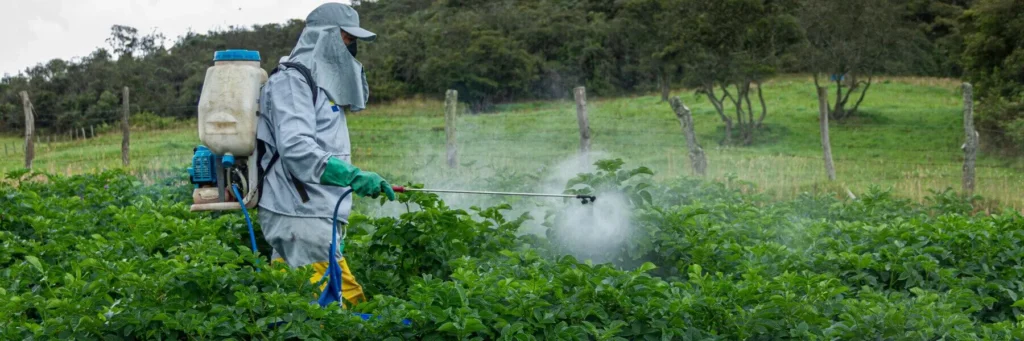
Paraquat is an herbicide, or weedkiller, sprayed on crops like grapes, apples, corn, and soybeans. About 50% of all table grapes are sprayed with paraquat. While U.S. farmers still apply paraquat on these crops, other countries successfully grow without its use. For example, four of the top ten apple-producing countries, representing 77% of production, have all banned paraquat. (China, EU, Turkey, Brazil)
Threats to Human Health
About 15% of people with Parkinson’s disease have a family history of the condition, meaning most cases are caused by environmental factors; paraquat is one of them. Peer-reviewed research shows that exposure to paraquat more than doubles a person’s risk of developing Parkinson’s disease—a progressive, incurable neurological disorder. As the disease takes hold, early symptoms can include difficulty walking, dementia, and depression. Parkinson’s disease is the fastest-growing brain disorder.
A recent UCLA study also confirms that living within 500 meters of fields sprayed with paraquat over time more than doubles the risk of Parkinson’s disease, compared to the rest of the region’s population.
Additionally, a study published in 2025 found that individuals living within one mile of a golf course where paraquat was applied had a 126% chance of developing Parkinson’s compared to those living six miles away.
Other serious health risks are also attributed to paraquat, including Non-Hodgkin’s Lymphoma, Thyroid Cancer, and numerous other thyroid issues. In a California study, the risk of Thyroid Cancer was increased due to the use of a number of pesticides, and paraquat in particular increased that risk in every model.
Environmental Harms
Paraquat is also detrimental to the natural areas to which it is introduced. Birds and mammals that encounter paraquat by consuming contaminated plants show decreased fertility and sometimes die from its effects. Pollinators are not immune to these harms either – paraquat can be moderately to highly toxic to bees depending on the species. Paraquat can remain in the soil for up to 7 years, consistently draining into nearby water sources and impacting wildlife.
When paraquat is applied, some of it is absorbed into the soil and nearby plants. The chemical also washes away, draining into freshwater environments – threatening freshwater fish and aquatic invertebrates. A study done by the EPA discovered that paraquat is toxic to freshwater fish and crustaceans, as well as aquatic invertebrates. In freshwater fish, exposure to paraquat caused tissue and cartilage damage and aneurysms. Exposure also damaged gill structure, impacting respiration and metabolism in fish.
Industry’s Secrets and Continued Profits
The chemical companies that produce paraquat, Syngenta and ChemChina, are based in Switzerland and China, two countries that have banned paraquat’s use. To be clear, the countries that produce paraquat and then sell it to the U.S. do not allow their own farmers to apply it.
Syngenta has been aware of the effects of paraquat for quite some time, yet has continued its production despite them. They repeatedly claim that the herbicide has no connection to Parkinson’s; meanwhile, Syngenta’s own research dating back to the 1950s completely contradicts the narrative that paraquat is safe.
Syngenta also lobbied to keep a prominent Parkinson’s researcher off an EPA panel in order to further protect their secret from disrupting their profits. Now, ongoing litigation is taking place, with 6,445 pending cases against Syngenta and its product.
Protecting Our Farmers
Farmers are the most impacted by this unnecessary poison, and across the U.S., have begun to tell their stories. Larry Wyles, for example, began to show signs of paraquat-induced Parkinson’s in 2001.
Paraquat’s strong connection to Parkinson’s disease presents an urgent need to protect our farmers and our communities from further chemical exposure.
Now is the time to end paraquat’s use for good in Vermont. The evidence is clear: paraquat poses serious risks to the people who apply it, live near it, and work in the fields where it is used—and safer alternatives already exist.
Sign up for action alerts to stay in the loop on this important issue:
Sign up for VPIRG Action Alerts
The best way to stay up to date on the latest opportunities to take action to protect the public interest in Vermont is by joining the VPIRG Action Alert list.